Press Ups
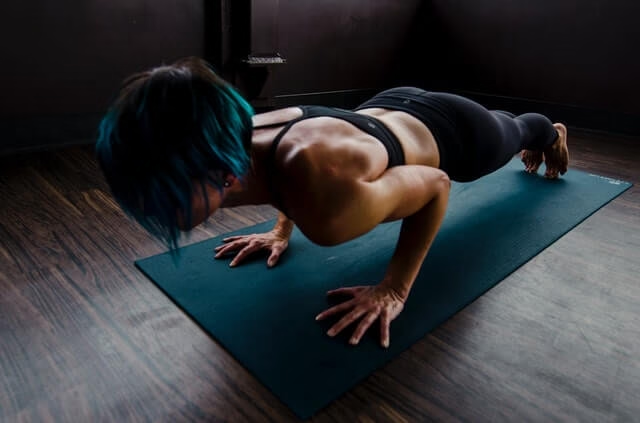
The press up is a foundational bodyweight exercise for the upper body, and a fantastic tool for developing functional, real-world relative strength.
It stands as one of the most effective compound movements you can perform, requiring multiple joints and large muscle chains to work together as a single cohesive unit against gravity.
Press ups are performed on the floor by lifting and lowering your body weight through the bending and straightening of your arms.
While many casual gym-goers classify it purely as a chest exercise, a strict press up puts massive mechanical tension across your chest (pectoralis major) and the front of your shoulders (anterior deltoids).
It also strongly engages the arms, forcing the triceps to drive your lock-out power while the biceps work behind the scenes to control your balance and stabilise the elbow joint on the way down.
Image header: Pexels
Types of Press Ups
One of the greatest advantages of calisthenics training is its flexibility. Press ups can be modified dynamically to match the current upper-body strength and joint mobility of the exerciser.
By shifting your body placement relative to the floor, you can safely scale the resistance up or down. There are three standard press up positions used to systematically build your upper-body strength:
The Box Press Up
To perform the box press up, kneel on a comfortable exercise mat on all fours with your back held flat and parallel to the ceiling. Ensure your knees are stacked directly underneath your hips and your hands are placed firmly on the floor directly beneath your shoulders.
The box press up is the most accessible variation to perform. Since your lower body supports its own mass entirely on your knees, you are only lifting a small percentage of your upper body. This makes it a perfect entry point for beginners looking to master the movement patterns without straining their joints.
Move yourself up and down smoothly to perform your repetitions by bending and straightening your arms. To protect your torso stability, focus on your breathing: inhale deeply on the way down to build intra-abdominal pressure, and exhale forcefully on the way up as you push through the floor.
Did You Know?
The Press-Up Loading Profile: When you perform a standard floor press-up, you aren’t just moving a random percentage. Biomechanical force-plate studies show you are physically lifting approximately 64% of your total body weight at the top of the movement.
If you drop down to a kneeling or modified variation, that loading profile drops to roughly 49%. The modified press-up is still a demanding compound movement that allows you to safely isolate your chest and triceps, perfectly priming your central nervous system to dominate the full floor variant later down the line.
The 3/4 Press Up
The 3/4 press up serves as an intermediate stepping stone, offering the next level of physical difficulty before tackling a traditional floor press up.
To perform the 3/4 press up, slide your hands forward from the standard box position so they sit just off the front edge of your exercise mat. Keep your hips extended forward so your thighs form a diagonal line from your knees up to your shoulders, keeping your head positioned above your palms.
While you’re still supporting your lower body on your knees, your centre of gravity shifts forward. Because your hips are now placed ahead of the knees, your chest and arms are forced to lift a much higher percentage of your body mass than they do in a box press up.
Keep an eye on your midsection during this variation. Ensure your core stays engaged so your hips do not sag toward the mat as you lower your chest.
The Full Press Up
The full floor press up is the classic baseline standard and the most challenging of the three variations.
To enter the setup for a full press up, maintain the hand and shoulder placement of the 3/4 variation, but lift your knees completely off the mat. Extend your legs straight behind you, anchoring your lower body on your toes like at the start of an abdominal plank.
Once you’re in this position, ensure your frame forms a straight line running from your shoulders through your hips all the way down to your ankles.
Avoid the error of sticking your bottom up in the air to ease the load, or letting your lower back sag down toward the floor. You should keep your abdominal wall and glutes braced to preserve this straight line.
The full floor press ups train your upper body in the same way mechanically as the classic barbell bench press. The primary difference is the stabilisation demand. So instead of lying flat on a supportive padded bench and pushing a free weight away from your chest, your entire body functions as the weight as you push yourself away from the floor.
Did You Know?
The Progression Science: You don’t need weights to make press-ups harder. A Journal of Physical Therapy Science study found that narrowing your hand placement drastically spikes muscle activation in your triceps and chest. Elevating your feet onto a standard gym box alters your biomechanical leverage, instantly scaling your bodyweight load profile up from 64% to over 73% of your total mass.
To discover more highly effective compound movements for boosting your chest and arm development, explore our step-by-step guides for the barbell bench press the overhead press, and unassisted parallel bar dips.
Pick Your Progression
Now that you know how to build a powerful chest and arms with press-ups, check out these guides to optimise the rest of your training routine:
- Master Your Core: A strict press-up requires an iron-clad midsection. Learn how to build deep abdominal endurance with our guide to the Abdominal Plank.
- Balance Your Upper Body: To protect your shoulders and build a balanced physique, you should pair your chest pushing with vertical pulling. Master the ultimate back builder with our comprehensive guide to Chin-Ups & Pull-Ups.
- Fuel Your Muscle Recovery: Building lean tissue with bodyweight movements requires the right nutritional building blocks. Explore our expert Nutrition & Fueling Guide.
💬 Share Your Thoughts!
We want to hear about your experience with bodyweight training:
- Your Current Level: Are you currently using the box variation to build strength, or are you cranking out full floor press-ups?
- The Workout Split: Do you like to use press-ups as a dynamic warm-up before hitting the bench press or as a high-rep finisher to burn out your chest?
- Your Milestone: What is your current personal record for a single set of strict, consecutive full press-ups?
Let us know your thoughts in the comments!


Leave a Reply