
Last Updated on October 22, 2026
Whether you’re lifting weights to increase strength, size or endurance, using the right load is critical to achieving your goals. If your working sets are miscalculated, you risk hitting a plateau or sustaining an injury. So, how do you spot the signs you are lifting too heavy in your day-to-day workouts?
Lifting with an excessive load is a common mistake in weight training, especially for beginners. To make consistent progress, you need to learn how to choose the right gym weight for your specific experience level and performance targets.
Finding your ideal training weight requires an accurate baseline, which is typically determined by your predicted single-rep max limit (i.e. the amount of weight you can lift with just 1 rep).
Every athlete should lift a specific percentage of their maximum capacity based on their goals. If you’re constantly missing reps or compromising your lifting technique, you’re likely overloading the barbell.
Training for Maximal Strength
If your primary goal is to increase muscle force, you should keep the resistance high and the repetitions low. This is the ideal strategy for lifters who want to maximise their lifting capacity on compound movements.
To optimise strength development, your training load should sit between 80% and 90% of your 1-rep max. At this high intensity, each working set should only consist of 4 to 6 repetitions before your muscles are fatigued.
Because heavy lifting places big demands on your central nervous system and joints, ensure you take 3 to 5 minutes of rest between your sets to fully restore your energy before your next set.
Training for Size
Lifting for size, that is, with the aim of achieving hypertrophy of the muscle, requires a different strategy. Increasing muscle volume is the core objective for lifters who want to improve their physique and build a larger, well-defined, muscular body.
To optimise your workouts for muscle growth, you should reduce the resistance slightly and increase the volume.
Keep your working intensity at roughly 70% to 80% of your 1-rep max and perform 8 to 12 repetitions per set. Rest intervals can be shortened to 60 to 90 seconds between sets to maximise metabolic stress.
Training for Muscular Endurance
Muscular endurance training requires a lower load, using light resistance to condition your muscle fibres to resist fatigue over longer periods.
This training style is ideal for athletes looking to improve their muscle capacity for running or other field sports. It’s also effective for burning calories to reduce body fat and increasing muscle definition without adding significant mass.
To train for endurance, select a load that sits around 55% to 65% of your 1-rep max. Your working targets should always exceed 12 repetitions, typically falling into the 15 to 20 rep range.
Rest periods are the shortest of any training style, lasting only 30 to 45 seconds to keep your heart rate elevated and build lactic acid tolerance.
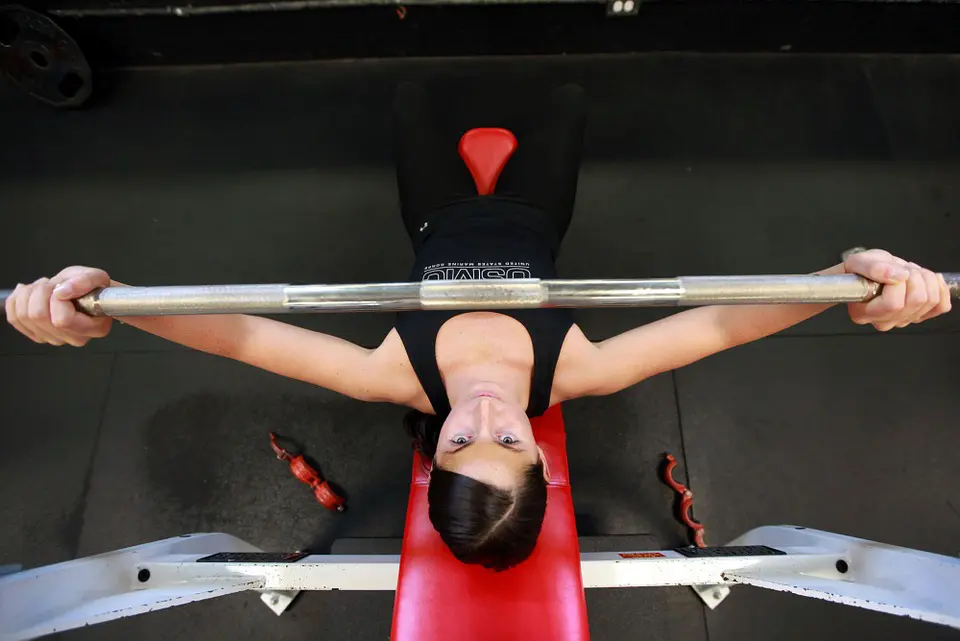
Image sourced via Pexels.
How to Spot the Signs You Are Lifting Too Heavy
It is often easy to tell if you are overloading the barbell because your structural form will immediately pay the price. For example, you should always be able to hit full parallel depth with your squats. If you find yourself cutting your depth short, the weight on your shoulders is simply too high.
You should never have to recruit secondary “helper” muscles to force your way through an isolation lift. For example, if you have to arch your upper back or swing your shoulders to force the cable down during a triceps extension, you are relying on momentum rather than muscle strength.
You should also be able to perform your lifts in a slow and steady motion, without the help of momentum. Keep an eye on yourself in the mirror and if you find your form is straining before your last rep, you should reduce the weight.
Pick Your Progression
Master Your Form: Don’t let heavy loads ruin your structural execution. Ensure you’re hitting perfect depth and protecting your joints by studying our comprehensive Guide to The Squat.
Fine-Tune Your Growth: Once you’ve fixed your working weights, maximise your targeted muscle hypertrophy by adding single-joint movements from our master Isolation Lifts Breakdown.
Beat the Plateaus: If your progress has stalled and you are struggling to add weight to the bar safely, map out your next steps using our guide to Overcoming Strength Training Plateaus.
Have you ever caught yourself lifting a too heavy just to hit a rep target? Let us know in the comments below if you prefer training for raw strength, size or endurance!


Leave a Reply